

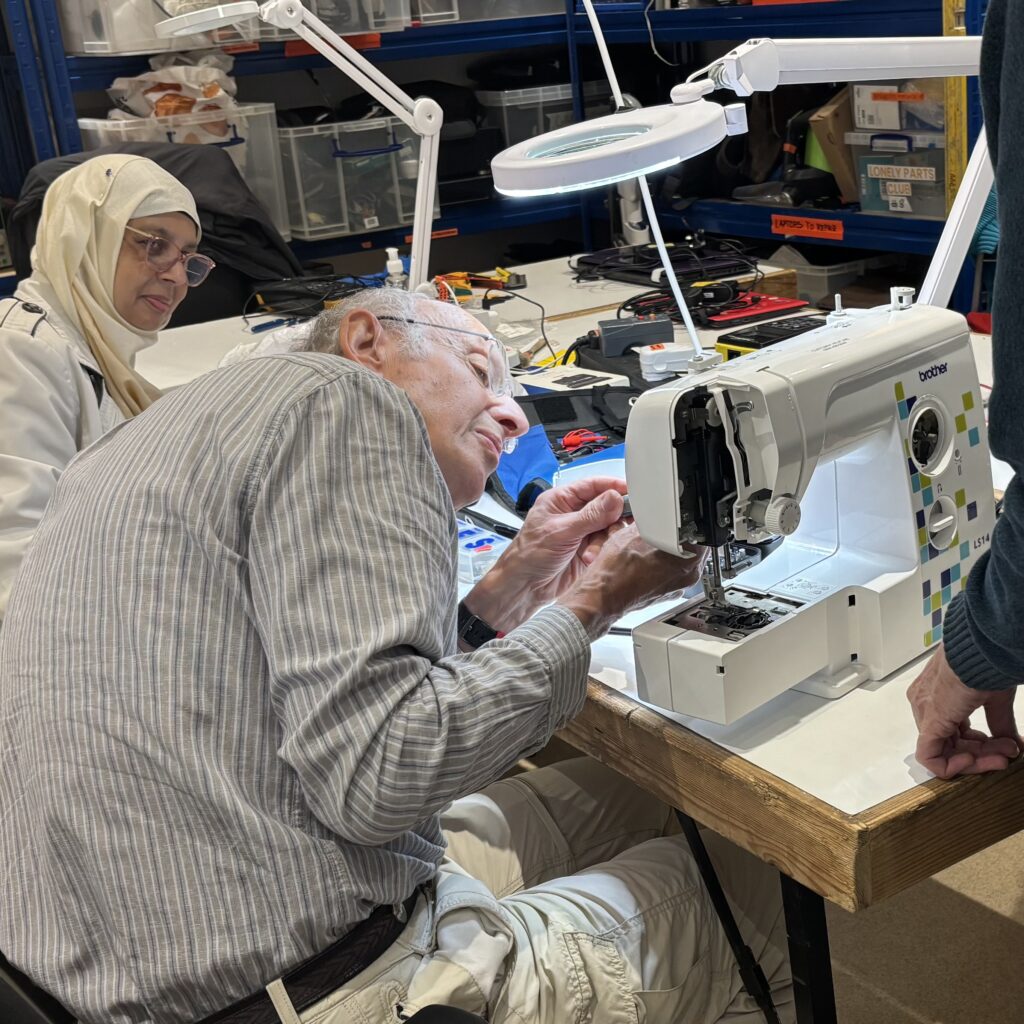
In a small workshop in Camden, north London, the sound of tools scraping against metal and plastic fills the room. A young woman leans over a workbench, watching as Isaac Winson – today’s stand-in manager – carefully opens up the broken kettle she has brought in. Together, they test the components, clean the contacts, and determine the source of the fault.
This is Fixing Factory, a permanent space for the public to have their appliances and gadgets fixed, free of charge. There’s a simple idea behind this joint venture between climate charities Possible and Restart Project: minimise landfill, save people money, and share repair skills.
But its significance runs deeper. “It’s about reducing demand for these items in the first place,” says Winson, who hopes that their model can be scaled-up and replicated across the UK and beyond.
Decarbonising our industries and moving away from fossil fuels is an essential and urgent task. But this transition will require massive amounts of critical minerals on top of the existing demand for consumer electronics and everyday items. Extending the life of what we already own can help ease the burden on supply chains, factories, and mines.
The International Energy Agency predicts that demand for lithium, a core component of batteries, may increase by up to 700 per cent by 2040. Demand for critical materials used in green technology, such as nickel, cobalt, and other rare earth metals, is predicted to at least double.
To power this transition, we’re mining more than ever. But according to Andy Whitmore, freelance researcher and co-founder of campaign alliance London Mining Network, the public don’t have a clear sense of the impact of these projects.
Mining locations are pre-determined by the natural distribution of materials and often proceed without the approval of local people.
“If you’re a community there, then you have to put up with it, and historically they’ve suffered,” Whitmore says.
This disproportionately affects those living in the Global South. An estimated 85 per cent of lithium is located on, or close to, Indigenous land. In the “lithium triangle” spanning Argentina, Chile, and Bolivia, extraction is causing land degradation and ecosystem disruption.
There’s always a ‘justification’ for mining… now it’s critical minerals and green transformation
Andy Whitmore
There are also humanitarian issues. Seventy per cent of the global supply of cobalt comes from the Democratic Republic of Congo, a politically unstable country with an opaque supply chain. Amnesty International has linked child labour and forced displacement to mining operations in the region.
Whitmore notes that cobalt and other materials are also used in warfare. He and his fellow campaigners are concerned that green technology is being used as a smokescreen to accelerate mining for military projects. They are calling for regulation to ensure transparency on how minerals are used.
“There’s always a ‘justification’ for mining. In colonial times it was just about making money, then it was industrialising, now it’s critical minerals and green transformation,” he says.
While regulation may help curb the worst excesses of the mining industry, it won’t eliminate the demand. The green transition still needs batteries, cables, and circuits, and that means more extraction. The challenge, then, is to meet this demand while mining as little as possible.
Projects like Fixing Factory achieve this on a local scale by keeping devices and resources in circulation. But this isn’t the only frontier of progress.
Steve Kench is the co-founder and chief technology officer of Polaron, a startup using artificial intelligence to optimise advanced materials design and manufacturing. While their materials have many applications, their primary focus is batteries, such as those used in electric vehicles.
“There are no real competitors to batteries in terms of how to store energy,” says Kench, “so we’re going to need lots of them in the future, regardless of how energy is produced.”
Polaron’s software uses machine learning to analyse the materials used in batteries and simulate changes, helping manufacturers find the optimal arrangement of particles to suit their needs.
Some of this is simply about efficiency – getting more power out of fewer materials faster. But increasingly, their work is also about sufficiency – helping clients understand how their battery needs to perform, identifying the least harmful way to meet this need.
“If a manufacturer knows how much energy per kilogram they need, then they can start to think about making processing less carbon-intensive, or using more recycled materials,” explains Kench.

While Polaron’s process doesn’t eliminate extraction, it ensures that minerals are used to their maximum potential by considering their impact, rather than a pursuit of performance at any cost.
Back in Camden, Winson finishes working on the kettle. He asks the young woman if she would consider coming to one of their training sessions and learning to fix gadgets herself. She eagerly agrees.
Repairing a humble kettle might be a drop in the ocean where minerals are concerned, but it demonstrates a valuable lesson in the green transition: to do the most with what we have before looking underground.