
At first glance, New Addington in Croydon feels like any other London borough. People are hurrying to work, smoking cigarettes at the tram stop, and weaving through crawling traffic. There are a few trees, some patches of grass, and little to suggest you’re anywhere close to nature. That is, until you reach the New Addington Circular.
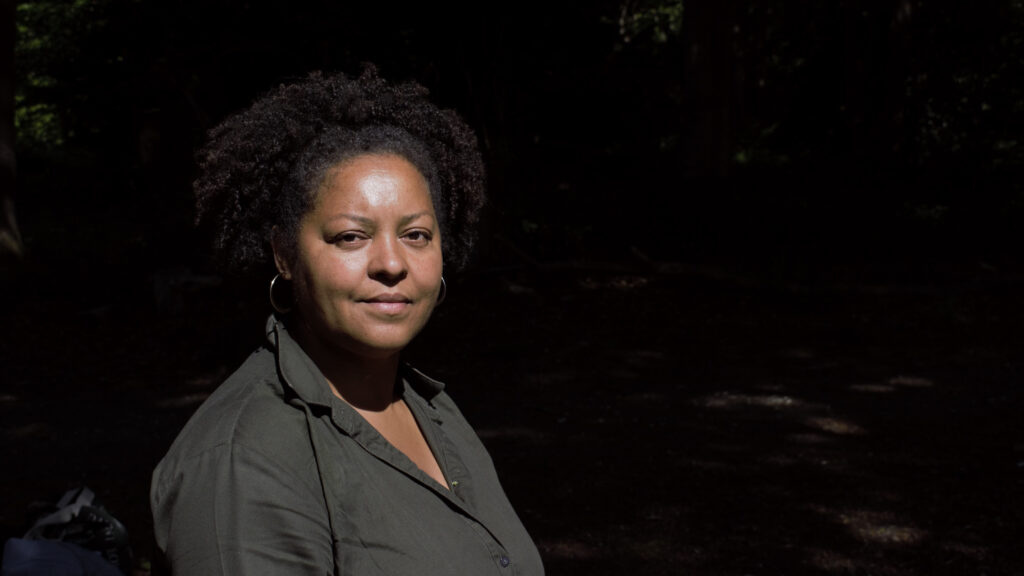
This peaceful nature reserve is home to psychotherapist Beth Collier’s Nature Therapy School, where for the past 10 years she has been practicing ecotherapy, helping people reconnect with the natural world and themselves
Here, Collier leads clients on walks through the woodlands, encouraging them to sit beside trees, listen to the birds, and talk to her as they process their emotions.
“This way of working is really effective with clients who have experienced trauma,” she explains, adding that “nature is so regulating” for our nervous systems.
For Collier, nature changes the way we experience emotion. Outside, our feelings “dissipate as if with the wind … indoors, the feelings and the stress just hang in the room.” Her path to this work was shaped by her own experiences of isolation.
Raised in rural Suffolk, she grew up without knowing any other people of colour. That sense of disconnection propelled her move to north Croydon, where 70 per cent of the population is Black and brown, where she has established her ecotherapy practice.
Yet here, she notes, access to green space is unequal. According to the Health Foundation, only five per cent of Black British, Caribbean or African people live in neighbourhoods with the most access to green space in the UK.
Collier is not alone in her endeavour. Over 8,000 miles away, in Cape Town, South Africa, clinical psychologist Chesney Ward-Smith also recognises the healing potential of nature.
Ward-Smith works with adolescents aged 12 to 18, many from under-resourced backgrounds. “Their main concerns are poverty, food, school,” she explains. “The idea is to help them connect with nature so that they can care about it.”
Access is an issue here, too. Many parks and reserves in Cape Town charge entrance fees, creating a barrier to those who can’t afford them. To help level the playing field, WardSmith works voluntarily to provide young people with equal access to the environment.
“To think of ourselves as separate from nature is a fallacy,” she says. “We’re not just here frolicking in the grass; there are real, tangible, scientific benefits to being here.”
Both Collier and Ward-Smith have faced scepticism for bringing psychotherapy outdoors.
“There was a lot of pushback in the beginning,” Collier admits, describing how psychotherapy can be ultra traditional in its approach.
Ward-Smith agrees, noting that Western clinical psychology tends to focus on the individual, while ecotherapy allows you to work outside in a group, where “you hope it would expand a sense of self for people.”
Both Croydon and Cape Town grapple with social inequality. For Ward-Smith’s young clients, that stress comes from trauma, poverty, and academic pressures.
“We’re working with dysregulated kids,” she says. “There’s a lot of stress in daily life, high unemployment, and so taking them into the forest, immediately you see a sense of just being able to breathe out.”
In London too, people of colour are more likely to live in areas with higher noise, air pollution, and limited green spaces – a reality Collier says deepens feelings of loneliness and shame, which have real health consequences.
This is rooted in the systemic racism of the environmental movement, she argues. “Wide open space is amazing because our bodies mirror it – that sense of expansion, opportunity, of seeing things differently.”
Farid Kelekun, project manager for Impact on Urban Health, a non-profit that addresses health inequalities in city life, echoes Collier’s concerns.
“The climate issue is not just an issue of temperatures warming up,” Kelekun explains. “It’s what happens to us once that happens. And how people are disproportionately affected by climate change as a social justice issue.”
In both Cape Town and London, it is those living in the most deprived areas who are the most affected. Cape Town has experienced reduced water supplies, increased heat, and multiple severe droughts, while London faces an increased number of heatwaves, heavy periods of rainfall, and a decrease in air quality.
For practitioners in both contexts, ecotherapy isn’t just a therapeutic tool, it’s a way to make nature accessible again.
“We’ll care for nature more when we come to understand our personal relationship with it,” Collier says. “If you’re not connected to it or there’s no nature left to connect to, that’s going to impact us. People underestimate relationally how traumatic that is.”
Ward-Smith shares that view. “If you can’t connect with nature, you’re not going to care about it.”